
Tool Suite
DEMO
Click here for the demo of the D-WISE Tool Suite:
the demo is currently under construction.
Note: For optimal use we recommend the browsers Firefox or Google Chrome.
The D-WISE Tool Suite (DWTS) is a working environment for digital qualitative discourse analysis in the Digital Humanities. It addresses limitations of current DH tools induced by the ever-increasing amount of heterogeneous, unstructured, and multi-modal data in which the discourses of contemporary societies are encoded. To provide meaningful insights from such data, our system leverages and combines state-of-the-art machine learning technologies from Natural Language Processing and Computer Vision.
The D-WISE Tool Suite is open-source. Please find source code and additional (technical) information here:
- GitHub repository (https://github.com/uhh-lt/dwts)
- Wiki (https://github.com/uhh-lt/dwts/wiki)
Key Features:
- Import: import of multi-modal data like text, image, audio, and video
- Preprocessing: preprocessing pipelines for enriching documents with additional information
- Exploration & Search: lexical and semantic search of documents
- Annotation & Coding: manual span, bounding box, time-span, and frame annotations
- Documentation & Reflection: documentation of the research process with user memos and automatic logs.
Tool Suite
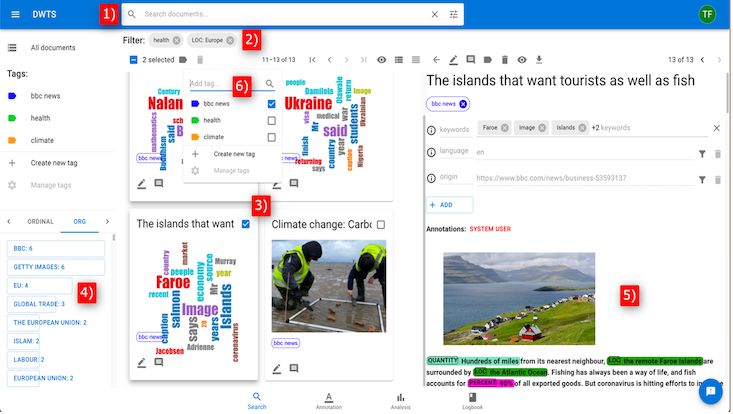
Photo: D-WISE
Components of the DWTS search interface: 1) Search bar for lexical search and filter options; 2) Currently applied filters; 3) Multi-modal search results; 4) Search results statistics; 5) Document viewer with tags, metadata, and annotations; 6) Tag editor popup.
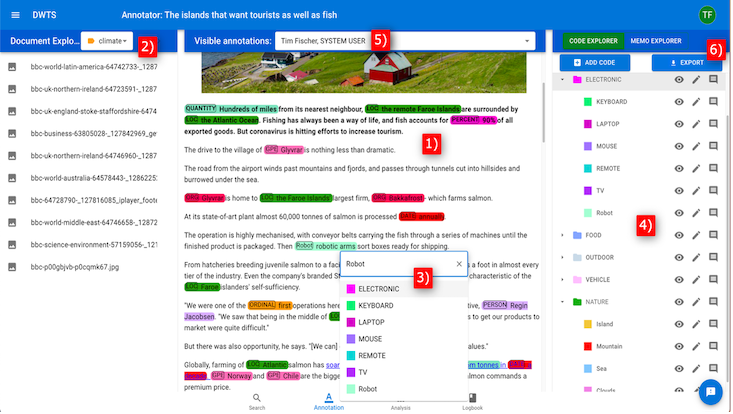
Photo: D-WISE
Components of the DWTS annotation interface: 1) The opened document with annotations of the current user and automatic annotations from the system; 2) Document explorer with tag selection; 3) Annotation editor popup for code selection; 4) Code explorer with hierarchical codes; 5) Annotation selection; 6) Annotation export button.
Development of the Tool Suite
The D-WISE Tool Suite is created for digital qualitative discourse analysis. We tackle the diverse challenges of multi-modal data, large amounts of data and the plurality of meanings, but we also address the question of how current ML technologies can be meaningfully integrated into human meaning production. In order to answer these questions, the DWTS is developed in close co-creation between anthropological studies in culture and history (EKW link to https://www.kulturwissenschaften.uni-hamburg.de/ekw.html) and language technology (LT link to https:// www.inf.uni-hamburg.de/en/inst/ab/lt/home.html).
Our co-creation concept is based on 3 building blocks:
User Stories
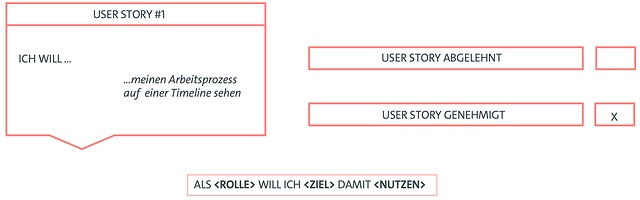
The User Stories form the interface of the interdisciplinary team; the collaborative work is created through the formulation of the research needs on the humanities side and their processing on the other technical side. In a constant exchange and reflection process with the manual WDA, desired formulations are given to the IT side, which in turn writes the program from the desired formulations. Hence the user stories are created in parallel with the research process and reflect the real-time requirements of the researchers, i. e. they cover all stages of qualitative research: from searching and collecting, coding and organizing, reflecting and writing, evaluating and visualizing as well as the possibility of a review of the research for reflection and publication purposes.
Hands-Ons
We use regular hands-ons for documentation, extensive testing and feedback on the current status of the tool suite, as well as for exchanging established methods for other qualitative and quantitative tools for data analysis. In addition, discourse analysis and hermeneutic work are further developed in this format with a view to the integration of ML technologies.
Fellow Workshops
The Fellow program is our way of preparing the tool suite for a wide range of research needs. We organize fellow workshops to discuss and consider the needs and perspectives of external researchers. This makes the system robust and versatile.